

From choosing outfits and locations to managing nerves and remembering the little details, here’s how to prepare for senior pictures you’ll love for years to come.
Senior picture day is coming up! You’ve booked your photographer, picked a date, and started thinking about what to wear. But now what? Do you need professional hair and makeup? How many outfits should you bring? What happens if it rains? And what if you’re one of those people who feels awkward every time someone points a camera at you?
After years of photographing high school seniors throughout Utah, I’ve learned that a little preparation can make an enormous difference in both the experience and the final photographs. I’ve also seen what happens when someone forgets their second outfit, arrives with wrinkled clothing, or spends the entire morning rushing to get ready. The good news? Most of these situations are completely avoidable. I’ve put together this senior picture day preparation guide to help you plan ahead, feel comfortable, and get the most out of your photography session. And I’ll share a few things I’ve learned behind the camera that might surprise you.
1. Start Planning Your Senior Pictures Before Picture Day
One of the biggest mistakes you can make is treating senior portraits as something you simply show up for. I believe the best sessions are collaborative. Your photographer brings the artistic and technical expertise, but you bring something equally important: your personality, interests, and ideas. At Aune Photo, I send clients a location guide and style guide shortly after booking. These help families start thinking about the possibilities before our planning consultation. During that consultation, we typically discuss three important things.
- Choose a Location That Matches Your Vision - I usually start with the location because most seniors already have a particular atmosphere in mind. Maybe you envision golden autumn leaves, an open field, an urban downtown setting, or something more dramatic and architectural. There’s no single best location for senior portraits. What matters is choosing a setting that complements your personality and the style of photographs you want. But here’s something people sometimes overlook -
- Your location and wardrobe need to work together - For example, if you want photographs in your football uniform, a field of wildflowers might not be the most natural setting for that particular outfit. That doesn’t mean we can’t make it work creatively. It simply means we should make that choice intentionally.
- Think About What Makes You Unique - Before your consultation, spend a little time thinking about what defines this chapter of your life. Are you an athlete? A musician? An artist? Someone who loves cars, reading, animals, or spending time outdoors? Is there a particular friendship, activity, or accomplishment you want to remember? I can help with posing, lighting, and locations, but I don’t know every detail of your life. Some of the most meaningful photographs happen when seniors share those details with me so we can incorporate them into the session.
2. Choose Outfits That Look Great and Feel Like You
What you wear is one of the most important decisions you’ll make when preparing for senior pictures. But my number one rule isn’t about colors, trends, or how expensive your clothes are. Wear something you feel comfortable and confident in. You could have the most beautiful outfit in the world, but if you’re constantly adjusting it, worrying about how it fits, or feeling like it isn’t really your style, that discomfort can show in your expressions. Your senior pictures should look like you, not someone you’re pretending to be.
What Colors Photograph Best? For my photographic style, I generally recommend lighter, softer colors such as:
- Tans, creams, and off-whites
- Light blues and muted greens
- Soft pastels
- Neutral and earthy tones
These colors often complement natural outdoor settings and work beautifully with the clean, timeless editing style I prefer. That doesn’t mean darker colors are off-limits. A black suit or tuxedo, for example, can look fantastic in the right setting. However, black clothing during outdoor sessions can show dust, lint, and other small distractions more easily. I also generally recommend avoiding large logos, busy patterns, and overly trendy clothing unless they’re intentionally part of the story you’re trying to tell.
How Many Outfits Should You Bring? For most senior sessions, I recommend planning two or three different looks, depending on your photography collection and available session time.
- Outfit 1: Casual and Comfortable - Choose something you’d genuinely enjoy wearing. It should reflect your everyday personality and allow you to move naturally.
- Outfit 2: Dressy or Formal - This might be a dress, a nice button-down shirt, a suit, or something you’d wear for a special occasion. Having both casual and dressy portraits gives you variety for graduation announcements, framed photographs, and social media.
- Outfit 3: Something That Represents Your Senior Year - This is where things can get especially meaningful. Consider a sports uniform, letterman jacket, cheer outfit, favorite prom dress, work uniform, or something related to a club or activity. These photographs can become a wonderful reminder of what mattered to you during high school.
Small Accessories Can Create Big Changes - You don’t necessarily need a complete outfit change to create a different look. A cardigan, for example, can be worn normally, draped over your shoulders, or removed entirely. That’s three different looks from essentially the same outfit. Layers, jewelry, jackets, and other accessories can add variety without taking additional time for wardrobe changes.
Consider Clothing That Allows Movement - I love incorporating natural movement into senior portraits. Walking, turning, laughing, and even twirling can produce wonderful photographs. If you’re wearing a full-length dress, a flowing skirt can make those movement-based portraits especially beautiful. And remember, your clothes should fit comfortably. Clothing that is overly restrictive or constantly needs adjustment can make the session less enjoyable.
3. Prepare Your Clothes the Night Before
Here’s a detail that sounds obvious but causes problems more often than you might expect. Make sure every outfit is clean, pressed, and ready to wear before picture day. I’ve had seniors arrive with clothing that looked like it had just come out of the dirty laundry pile. Sometimes there are food stains. Other times, a shirt is covered in wrinkles because it was never properly prepared. Yes, I can sometimes remove wrinkles or minor distractions during editing. But digital editing has limitations, and extensive corrections can require additional time and potentially additional expense. I can’t always make a heavily wrinkled shirt look freshly pressed.
The night before your session:
- Wash or clean every outfit that needs it.
- Iron, steam, or press clothing as appropriate.
- Check for stains, lint, and loose threads.
- Place each outfit on a hanger.
- Match shoes and accessories with each outfit.
- Put everything together so nothing gets left behind.
And that last point is more important than you might think. I’ve had approximately three sessions where someone forgot to bring their change of clothes entirely. That meant someone had to leave to retrieve them or arrange for another person to bring them. Beyond losing valuable photography time, it can disrupt the entire session when a particular outfit was planned for a specific location. My advice: Don’t just choose your outfits in advance. Physically pack them the night before.
4. Plan Hair, Makeup, and Grooming Ahead of Time
Your goal should be to look like yourself on a day when you feel especially good. That doesn’t necessarily mean getting professional hair and makeup or dramatically changing your appearance. It means taking care of the details that matter to you.
Schedule Haircuts in Advance - If you’re planning a haircut, I generally recommend scheduling it about a week before your session. I’ve had multiple clients arrive overdue for a haircut and later ask whether I could digitally give them one. Sometimes minor adjustments are possible. But recreating a haircut through editing can be difficult, time-consuming, and may involve additional charges. It’s much easier to plan ahead.
Should You Get Professional Hair and Makeup? - This is entirely a personal preference. If you enjoy dressing up, having your hair professionally styled, and adding a little extra polish to your appearance, professional hair and makeup can be a wonderful addition. But if you’re someone who normally spends five minutes getting ready and prefers a simple, natural appearance, a dramatic professional makeover might not feel like you. And that’s perfectly fine. Professional hair and makeup can enhance your senior portrait experience, but they’re absolutely not required. The most important thing is that you recognize yourself in the finished photographs.
Don’t Forget Your Fingernails - This is one of the most common little details I see overlooked. Chipped fingernail polish, especially in a contrasting color, can be surprisingly noticeable in photographs. Hands frequently appear in portraits, whether you’re holding a prop, adjusting your hair, or resting your hands in a natural pose. Before your session, check your nails. If you wear polish, make sure it’s fresh or remove any chipped polish. It’s a small detail that can save unnecessary editing later.
Bring Touch-Up Essentials - Outfit changes, wind, and normal movement can disrupt hair and makeup. I recommend bringing a small bag with a hairbrush, lip balm or lip gloss, and any makeup you may want for quick touch-ups. You probably won’t need everything, but it’s nice to have it available.
5. Bring Props That Tell Your Story
One of my favorite parts of senior photography is incorporating meaningful personal items. A great senior portrait isn’t always just about how someone looks. It’s also about who they are. I’ve photographed seniors with musical instruments, sporting equipment, cars, stuffed animals, letterman jackets, and other personal keepsakes. And sometimes the most meaningful addition isn’t an object at all.
A Volleyball, a Best Friend, and a Moment Worth Remembering - I once photographed a senior who played volleyball. She brought her volleyball, and we created some fun, casual portraits that reflected her involvement in the sport. But she also brought her teammate and best friend. It was a last-minute addition to the session. I posed the two of them near a fence and encouraged them to simply talk and interact. Before long, they were laughing and enjoying each other’s company while I photographed them just being friends. There was nothing particularly elaborate about the setup. But those photographs captured something that I believe will become increasingly meaningful over time: a friendship and a moment in their lives that they’ll never experience in quite the same way again. That’s what I love about senior photography. We’re not just creating attractive pictures. We’re documenting memories. If you plan to include another person in your session, discuss it with your photographer beforehand. Additional participants may need a signed session agreement and, when applicable, parental consent.
6. What If You’re Nervous or Don’t Like Having Your Picture Taken?
First, you don’t need to know how to pose. That’s my job. Some seniors are naturally comfortable in front of the camera. Others are extremely nervous. I’ve even had parents quietly pull me aside before a session to warn me that their senior produces an incredibly forced smile whenever someone tells them to smile. That’s useful information! Because here’s something important to remember: Not every photograph needs a smile. Some of my favorite portraits feature serious expressions, thoughtful looks, or someone simply looking away from the camera. There are many ways to create natural, beautiful photographs.
Practice Before Your Session - If you’re especially nervous, consider asking a friend to spend a little time taking pictures of you with a phone. Go to a park, a field, or somewhere you enjoy spending time. Pretend you’re a fashion model for a little while. Try different poses, walk around, laugh, and experiment. The goal isn’t to master posing. It’s simply to become more comfortable having a camera pointed in your direction.
Start With Something Familiar - Sometimes I’ll begin a session with a meaningful prop or an activity the senior enjoys. Holding a musical instrument, tossing a ball, or interacting with something familiar can make the experience feel less like a formal photoshoot. And sometimes, we just talk. We discuss hobbies, school, future plans, and whatever else comes up. Occasionally, I’ll even invite a family member to help create a lighthearted moment that brings out a genuine laugh. The best smiles are often the ones that happen when someone isn’t thinking about smiling at all.
7. Parents: Your Role Matters More Than You Might Think
Parents can be incredibly helpful during senior portrait sessions. But the most effective role depends on the senior. Some seniors feel more comfortable when a parent is nearby. Others become more nervous when they feel like someone is constantly watching, correcting, or commenting on their appearance. I’ve seen both situations.
How Parents Can Help - Parents are wonderful at managing the practical details. You can help carry clothing, organize accessories, assist with outfit changes, and hold phones or other items that shouldn’t be in pockets during photographs. You may also notice details that I wouldn’t immediately recognize as something needing adjustment. For example, a parent might notice that makeup has shifted or doesn’t look the way their senior intended. Those observations can be genuinely helpful.
When It’s Better to Step Back - One thing I encourage parents to remember is that you’ve hired an experienced photographer for a reason. Some poses that look beautiful in a finished photograph may actually look slightly unusual when you’re watching them happen. A parent who continually tries to adjust the pose may unintentionally interfere with what the photographer is creating. And frequent reminders to smile, stand straighter, or fix something can sometimes make a nervous senior even more self-conscious. The best approach is to pay attention to how your senior is responding. If your presence helps them relax, wonderful. If they seem more comfortable with a little independence, give them some room. The goal is to create an experience where your senior can be themselves.
8. Prepare for Utah’s Unpredictable Weather
Outdoor senior photography in Utah means working with changing weather. But contrary to what some people might think, we don’t need perfectly sunny skies to create beautiful portraits. In fact, I often prefer cloudy or partly cloudy conditions because the softer light can reduce harsh shadows. A little wind can also add wonderful movement and drama to an image.
When Should You Reschedule? - I generally consider rescheduling when the wind becomes excessive or when significant rain is expected. However, weather decisions depend on the person, their hairstyle, the location, and the kind of photographs we’re trying to create. Someone with long, thick hair may find wind more challenging than someone with shorter hair. And a light drizzle doesn’t necessarily mean we need to cancel. I recently photographed a family during a slight drizzle, and we ended up capturing portraits with rainbows in the background. Those became some wonderfully memorable images. Sometimes unexpected weather gives us something special.
Bring Shoes for Walking - Here’s another practical tip that can save you a lot of frustration. If your session involves an outdoor field, trail, or natural setting, bring comfortable shoes for walking between locations. This is especially important if it has rained recently and the ground may be muddy. I’ve seen seniors arrive in formal outfits with high heels, only to discover that walking to the photography location is more challenging than expected. My recommendation is simple: Walk to the location in safe, comfortable shoes, then change into your dress shoes or heels when we’re ready to photograph. It’s easier, safer, and helps keep your nice shoes clean.
9. Give Yourself More Time Than You Think You Need
If I could offer one practical piece of advice for the morning of your senior session, it would be this: Figure out how much time you think you’ll need to get ready, then add another 30 to 45 minutes. Something always seems to come up. Maybe an outfit needs another quick press. Maybe hair takes longer than expected. Maybe someone can’t find the shoes they planned to wear. Whatever it is, those last-minute problems are much easier to handle when you’ve allowed extra time. The last thing I want is for someone to arrive at their session already feeling rushed, frustrated, or anxious. A little breathing room in your schedule can make a meaningful difference.
10. The Complete Senior Picture Day Checklist
Here’s a practical checklist you can use to prepare for your senior portraits.
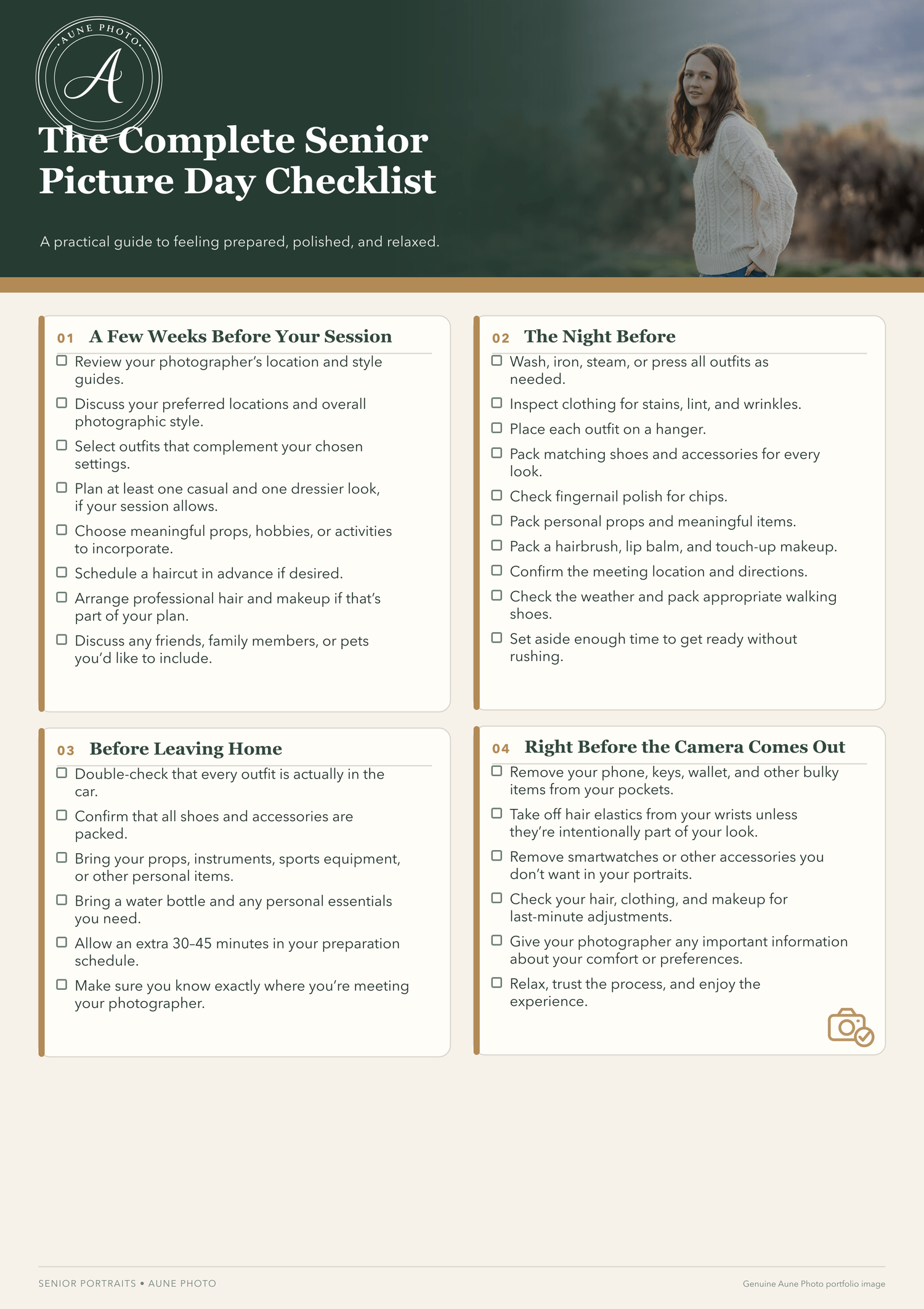
And one final reminder about those hair elastics: I see them on wrists all the time! When I’m looking through the camera, they can appear to be an intentional accessory. Later, clients sometimes request that I remove them from every photograph. Taking them off before we begin is much easier than digitally removing them afterward.
11. What Happens After Your Senior Portrait Session?
Once the session is complete, your photographer will begin preparing your images. At Aune Photo, I review the photographs and prepare a private online Selection Gallery, typically within a week. You’ll have the opportunity to browse the images and choose your favorites. Those selected photographs then receive individual attention during the editing process, including color refinement, natural retouching, and the removal of minor distractions when appropriate. The finished high-resolution portraits can be used for graduation announcements, social media, prints, and other keepsakes. My goal is to deliver photographs that feel authentic to you while maintaining a polished, timeless appearance.
Final Thoughts: You Are the Most Important Part of Your Senior Pictures
We’ve talked about outfits, locations, hair, makeup, props, weather, and everything you should remember to pack. All of those things matter. But I want to leave you with something I believe is even more important.
You are someone amazing.
Every senior I’ve photographed has their own personality, talents, interests, accomplishments, and potential. Some are outgoing. Others are quiet. Some know exactly what they want to do after graduation, while others are still figuring it out. And every one of them has something worth celebrating. You’re important to the people in your life. That’s one of the reasons these photographs matter so much. Your senior portraits aren’t about becoming someone else for the camera or trying to look like the people you see on social media. They’re about capturing who you are at this remarkable moment in your life. You’re the truly amazing one. I’m just the photographer trying to capture a little of that amazingness in a picture.
Ready to Plan Your Senior Portraits?
At Aune Photo, I specialize in creating timeless, natural senior portraits that celebrate each senior’s personality and story. From selecting locations and coordinating outfits to guiding poses and capturing genuine expressions, I’ll help you through every step of the process. If you’re planning senior pictures in the Salt Lake City or Davis County area, I’d love to help you create something meaningful.
Explore Aune Photo’s Senior Portrait Experience and Pricing


