

Golden hour gets most of the attention, but the best lighting for your senior or family pictures depends on more than the sunset. Here's what I consider when planning portrait sessions in Utah.
You've probably heard that golden hour is the best time to take pictures. And there's a reason photographers love it. That beautiful, warm sunlight just before sunset can create soft, flattering portraits with a gorgeous golden glow. It's particularly popular for senior pictures in open fields, among autumn leaves, and other natural outdoor settings.
But here's something that might surprise you. Golden hour isn't always the best time for senior portraits. In fact, depending on the location and the type of photographs you're hoping to create, scheduling your session during golden hour might actually make it harder to achieve the look you want. As a senior and family portrait photographer in Utah, I approach scheduling a little differently than simply looking up the sunset time. I start with the location, consider the photographic style the senior wants, and then determine the best time of day to bring that vision to life. Let me explain why.
What Is Golden Hour in Photography?
Golden hour is the period shortly after sunrise or before sunset when the sun is low in the sky. Because sunlight travels through more of Earth's atmosphere at these low angles, more of the shorter blue wavelengths are scattered out of the direct sunlight. This leaves the light appearing warmer, with more yellow, orange, and red tones. The low angle of the sun also creates a different quality of light than you'd typically encounter in the middle of the day. Some of the characteristics photographers love about golden hour include:
- Warm colors: Sunlight can produce beautiful golden tones in skin, clothing, and surrounding landscapes.
- More flattering light: Compared with direct midday sunlight, the lower sun can make it easier to avoid harsh overhead shadows.
- Beautiful backlighting: Positioning the sun behind a senior can create a soft glow around their hair and shoulders.
- Longer shadows: The low angle of the sun creates opportunities for depth, texture, and dramatic compositions.
- A softer atmosphere: Especially toward sunset, the light often becomes less intense and more forgiving.
These qualities make golden hour particularly appealing for natural, relaxed senior portraits. But there's one important detail. Golden hour isn't a fixed 60-minute window. Its duration and appearance depend on the season, latitude, atmospheric conditions, and surrounding landscape. And here in Utah, our mountains can make a particularly big difference.
When Is Golden Hour in Utah?
Golden hour occurs twice each day: once after sunrise and again before sunset. However, the actual clock time changes dramatically throughout the year. During summer, sunset in the Salt Lake City area can occur around 9:00 PM. In the middle of winter, it can be around 5:00 PM. That means a summer senior portrait session might begin around 7:30 PM to capture the changing evening light, while a winter session might need to begin much earlier. These are approximate examples, not universal appointment times. The ideal schedule depends on the date, location, and type of photographs we're creating.
Why I Often Start Before Golden Hour
When I'm planning a session specifically around evening golden-hour lighting, I often like to begin approximately 90 minutes before sunset. Why not wait until the sun is almost down? Because the light changes significantly during that period. At the beginning of the session, we may have brighter, more neutral light that works well for certain outfits or locations. As the sun gets lower, we transition into warmer, softer conditions. And near sunset, we may have opportunities for dramatic skies or beautifully backlit portraits. Starting earlier gives us more flexibility.
For example, if a senior wants a combination of casual, slightly edgy portraits and more formal, romantic photographs, we might begin as much as two hours before sunset. We can use the earlier light for the stronger, more dramatic look and save the dressier outfit for the softer light later in the session. It's a way of creating variety rather than making every photograph look like it was taken under identical lighting.
Why Golden Hour Isn't Always the Best Choice
Here's the most important point I want seniors and parents to understand. The best time of day is the time that produces the lighting appropriate for the photographs you actually want. Not every senior wants the same look. Some want soft, romantic portraits in a field of flowers. Others want urban photographs with concrete, brick, steel, and dramatic shadows. Some want athletic portraits that emphasize strength and movement. Others want something moody, cinematic, or even fantasy-inspired. Those styles don't necessarily benefit from the same lighting.
Soft, Natural Portraits
If you're envisioning flowing dresses, open fields, autumn foliage, and warm, natural colors, golden hour may be an excellent choice. I particularly like it when the senior is wearing lighter, muted colors that complement the natural environment. The warmth of the sunlight can enhance the atmosphere without overpowering the photograph.
Urban and Editorial Portraits
For an urban senior session, I may recommend earlier in the day or early evening rather than golden hour. Why? Because buildings, concrete, brick, and other urban surfaces reflect light differently. Warm sunlight can introduce color casts that don't necessarily complement the environment or the senior's clothing. And sometimes, the goal isn't a warm, glowing photograph at all. Maybe we're looking for more texture, stronger contrast, or dramatic shadows. In those situations, a different time of day may produce a better result.
Athletic and Dramatic Portraits
Sports portraits are another example. If we're photographing a senior in their athletic uniform and want a powerful, dramatic look, I might intentionally choose lighting that creates stronger directional shadows. That kind of lighting can emphasize texture, shape, and dimension. Soft golden-hour light is beautiful, but it isn't automatically the most effective choice for every creative vision. The key is to decide what we're trying to accomplish before deciding when to shoot.
In Utah, the Mountains Can Change Everything
One of the biggest challenges with scheduling golden-hour photography in northern Utah is our geography. In the Salt Lake and Davis County areas, we have the Wasatch Mountains to the east and the open valley to the west. That geography affects how sunlight reaches different locations throughout the day. And the official sunset time doesn't tell the whole story.
Mueller Park Canyon and Memory Grove Park
Mueller Park Canyon and Memory Grove Park, great locations for photographs, both have areas where the surrounding terrain and trees can block direct sunlight well before the official sunset. If we wait until the conventional golden-hour window, we may find ourselves photographing in deep shade rather than beautiful, direct golden sunlight. That doesn't mean we can't create great portraits there. It simply means the lighting conditions are very different from what someone might imagine when they hear the words "golden hour." In those situations, scheduling earlier in the day may provide more useful natural light. And depending on the look we're going for, earlier lighting may actually be preferable.
Downtown Buildings Create Similar Challenges
The same principle applies to urban locations. Tall buildings can block direct sunlight and create large areas of shade. Sometimes that's beneficial because the shade provides relatively soft, even lighting. Other times, it means the warm sunset light never reaches the area where we're photographing.
This is why I always consider the specific location before recommending a session time. Two locations just a few miles apart can have completely different lighting conditions at exactly the same moment. The sunset time tells us where the sun is. The location determines whether that sunlight actually reaches us.
Is Morning Golden Hour as Good as Evening Golden Hour?
Most people associate golden hour with sunset. But golden hour also happens after sunrise. Morning sessions have some advantages that are easy to overlook. For starters, seniors often arrive feeling fresh, with recently styled hair and makeup. Popular photography locations are also generally less crowded in the morning. That can be particularly helpful when photographing in places where several photographers may otherwise be competing for the same scenic spots.
The Utah Mountain Factor
There's an important difference between sunrise and sunset photography here in the Salt Lake Valley. Because the Wasatch Mountains are east of us, they can block the rising sun. By the time direct sunlight clears the mountains and reaches some valley locations, the sun may already be relatively high in the sky. As a result, the morning light doesn't always produce the same rich golden tones we often associate with evening golden hour. That doesn't mean morning photography is inferior. Early morning can still provide beautiful, soft light, particularly in open areas or locations that receive direct sunlight sooner. But I wouldn't automatically assume that sunrise and sunset will produce identical results.
When I'd Recommend a Morning Session
Morning photography may be an excellent option if you:
- Prefer fewer crowds at popular locations.
- Want your hair and makeup photographed while they're freshly styled.
- Enjoy cooler temperatures during warmer months.
- Want soft natural lighting without necessarily needing a dramatic orange sunset.
- Have a location that works especially well with morning light.
As always, the location and desired style should guide the decision.
How Do the Seasons Affect Senior Portrait Lighting?
The time of year has a major impact on the available light. And it's about more than simply whether sunset happens early or late.
Summer: Long Evenings and Warm Sunset Light
Summer offers long days and relatively late sunsets. That provides plenty of opportunities for evening photography, although it can also mean sessions run later than some families expect. Summer golden hour can create beautiful warm colors, especially in open natural settings. However, if we're shooting earlier in the afternoon, direct sunlight may be quite intense. In those situations, I may look for open shade, adjust the direction we're photographing, or use supplemental lighting.
Fall: Beautiful Color and Earlier Sunsets
Fall is one of my favorite seasons for outdoor portraits. The changing leaves can create incredible backgrounds, and the warmer tones of evening sunlight often complement the autumn colors. But as the season progresses, sunset arrives earlier. That means we need to plan around school schedules and the available daylight. A location that worked beautifully at 7:30 PM in August might require a very different schedule in October.
Winter: Softer Sunlight and Reflective Snow
Winter photography introduces some interesting lighting opportunities. The sun remains lower in the sky throughout the day, so even around noon, the light comes from a lower angle than it does during summer. That can create directional shadows and a different sense of depth. But there's another factor that makes winter photography especially interesting.
Snow.
When there's snow on the ground, sunlight reflects upward from the white surface. On an overcast winter day, the clouds can act like a giant diffuser overhead while the snow acts like a large natural reflector below. The result can be beautifully even ambient lighting. I've photographed sessions during snowfall, and the atmosphere can be absolutely magical. Those conditions have produce some of my favorite portraits, even without a traditional golden-hour glow.
Spring: Flexibility and Changing Conditions
Spring brings longer days and increasing opportunities for outdoor sessions. However, the weather can change quickly. Cloud cover, rain, and shifting temperatures can all affect our plans. Rather than selecting a time based solely on sunset, I prefer to consider the location, expected weather, and the look the senior wants. Sometimes a cloudy spring afternoon can provide more useful lighting than a bright, sunny evening.
Why Cloudy Days Can Be Better Than Sunny Days
There's a common misconception that a bright, sunny day is automatically the best day for pictures. In reality, bright, direct sunlight can be some of the most challenging lighting for portrait photography. When the sun is high overhead, it can create strong shadows beneath the eyes, nose, and chin. It can also make people squint, particularly when they're facing toward the sun. And if the background is much brighter than the subject, balancing the exposure becomes more difficult. A completely overcast day has its own advantages. Clouds spread the sunlight across a much larger apparent light source, reducing harsh directional shadows. That gives us more freedom to photograph in different directions. We don't have to worry as much about someone squinting into direct sunlight. And we can often use locations that would be difficult to photograph under clear skies at the same time of day. The trade-off is that we may not get the warm, golden glow associated with sunset. But that isn't necessarily a problem. For certain styles, neutral, even lighting is exactly what we want.
My Favorite Conditions for Soft Portraits
For a soft, natural senior session, one of my favorite scenarios is approaching golden hour with partly cloudy skies That combination can provide the warmth of the lower sun while allowing clouds to soften the light when they pass in front of it. It's not a guarantee, since clouds can also block the warm sunlight completely, but it can create wonderful conditions.
Should You Reschedule for Rain or Snow?
Not automatically. I've photographed sessions in light rain, drizzle, and snowfall. Those conditions can create beautiful, distinctive photographs. Of course, we also need to consider comfort, hairstyles, clothing, and safety. A little drizzle may work wonderfully for one session but be completely inappropriate for another. The important thing is to communicate with your photographer rather than assuming imperfect weather means imperfect photographs.
The Difference Between Golden Hour, Sunset, and Blue Hour
These terms are sometimes used interchangeably, but they describe different lighting conditions. Understanding them can help you explain the kind of photographs you want. One important distinction is that golden hour and blue hour are approximate photographic terms, not fixed one-hour periods. Their timing varies with the season and location. And here's where professional lighting becomes particularly useful.

The Biggest Misconception About Sunset Portraits
One of the most common expectations I encounter is that we can simply photograph someone with a brilliant orange sunset behind them and capture both the person and the sky perfectly. Unfortunately, photography doesn't usually work that way. Here's why. Your Eyes and Your Camera See Light Differently. Our eyes are remarkably good at adapting to different brightness levels. When you're standing outside watching a beautiful sunset, you can usually see both the colorful sky and the people standing in front of you. But the camera has a limited ability to capture very bright and very dark areas in a single exposure. When the sunset is much brighter than the person we're photographing, we have a choice.
Option 1: Expose for the sunset.
The sky retains its beautiful color and detail, but the senior may become very dark or even appear as a silhouette.
Option 2: Expose for the subject.
The subject looks properly illuminated, but the sky may become very bright, losing much of the dramatic sunset color.
Neither result is necessarily wrong. Silhouettes can be beautiful. But if you want a richly colored sunset and a naturally illuminated senior, we may need to take additional steps.
Why Can't We Just Fix the Sky in Editing?
Sometimes clients ask whether we can simply darken the sky afterward to restore the sunset colors. The problem is that if part of the sky is completely overexposed, the original color and detail may no longer be present in the image. Editing software can't reliably recover information that wasn't captured. There are techniques that can help, including combining multiple exposures or selectively adjusting parts of an image. But those methods have limitations. Trying to dramatically brighten a dark subject can introduce unwanted noise. Heavy masking around hair and other fine details can create visible artifacts. And replacing the sky entirely may produce a result that doesn't look natural. That's why I prefer to get the lighting as close to correct as possible when taking the photograph.
How Professional Lighting Changes Everything
Many people hear the term "studio lighting" and immediately picture a photographer working indoors with a backdrop. But professional lighting can be just as valuable outdoors. In fact, I believe portable studio lighting is one of the most useful tools a portrait photographer can bring to an outdoor session. It allows me to control how the senior is illuminated without depending entirely on the available sunlight.
Beautiful Sunset, Beautifully Lit Senior
This is one of the situations where portable strobes can make an enormous difference. Instead of choosing between a properly exposed sunset and a properly exposed person, I can expose the photograph to preserve the sunset's colors. Then I use a portable strobe to illuminate the senior. By adjusting the light's power and using a modifier such as a softbox or octabox, I can create flattering, balanced light on the person while maintaining the rich colors of the sky. We get the best of both worlds. I've used this technique frequently during sunset sessions, particularly over the past year. And it's a major reason I recommend considering supplemental lighting when dramatic sunset portraits are part of the vision.
Soft Light in the Middle of the Day
Portable lighting can also help during midday sessions. If the available sunlight is creating unflattering shadows, a carefully positioned strobe with a diffuser can help soften or fill those shadows. It gives us more control over the subject's appearance, even when the surrounding lighting isn't ideal. That doesn't mean every harsh lighting problem disappears, but it provides creative options we wouldn't otherwise have.
Correcting Unwanted Color Casts
Here's another problem most people don't think about. Imagine photographing a senior in a dense forest surrounded by green leaves. Sunlight reflects off those leaves and nearby surfaces. That reflected light can introduce a green color cast onto the person's skin and clothing. Similarly, brightly colored buildings or walls can reflect unwanted colors onto a subject during an urban session. Using a strobe with appropriately balanced light allows me to illuminate the senior more neutrally while preserving the natural colors of the surrounding environment. It's a subtle difference, but it can make the finished portrait look much more polished.
A Creative Example: Photographing a Fantasy Scene After Golden Hour
One of my more unusual creative sessions involved a fantasy-inspired concept in a wooded canyon. We wanted the photographs to feel dark, atmospheric, and almost nighttime-like. Golden hour wasn't the right choice for that vision. Instead, we photographed later, when the natural light had transitioned toward blue hour. That gave the surrounding forest a cool, blue appearance that helped create the mood we wanted. But there was a challenge. If we relied entirely on the available light, the subject would also take on that blue color cast. So I brought a portable strobe with a softbox. That allowed me to illuminate the subject with more neutral, natural-looking light while leaving the surrounding forest cool and moody. The contrast between the subject and the environment helped tell the story.
And that's the point I want to emphasize. Sometimes the best photograph happens when we intentionally choose lighting that most people would consider less than ideal. The goal isn't always to make everything bright, warm, and evenly illuminated. The goal is to create the photograph we envisioned.
Do You Need Professional Lighting for Senior or other Portrait Pictures?
Not necessarily. Beautiful senior portraits can absolutely be created using natural light alone. In fact, golden hour is popular partly because it makes soft, flattering natural lighting easier to achieve without additional equipment. But professional lighting gives us more options. It can help when:
- A senior's schedule requires a midday session.
- A location is heavily shaded.
- The surrounding environment creates unwanted color casts.
- We want to preserve the detail and color of a dramatic sunset.
- The desired style calls for more controlled or directional lighting.
- We want a consistent look even when natural light changes.
It's also worth noting that professional lighting doesn't always mean soft lighting. By changing the light modifier, position, and intensity, I can create everything from soft, flattering illumination to stronger, more dramatic shadows. Using gels can even change the color cast and make a daytime picture look like golden hour. That flexibility is particularly useful for seniors who want a more editorial, athletic, or edgy look. My recommendation is to discuss the option with your photographer and understand what it could add to your session. You shouldn't feel obligated to use equipment you don't need. But you should know what's possible before deciding.
So, What Is the Best Time of Day for Senior Portraits?
After all this discussion about golden hour, here's how I actually approach scheduling senior portrait sessions. I consider three things, in this order.
1. Choose the Location - Where are we photographing? Is it an open field, a wooded canyon, a downtown street, or a mountain setting? How does the sun reach that location? Are there trees, buildings, or canyon walls that will block the light? The location tells me which lighting conditions are realistically available.
2. Decide on the Photographic Style - What do you want your photographs to look and feel like? Soft and romantic? Natural and relaxed? Dramatic and athletic? Urban and edgy? Moody and cinematic? The desired style helps determine whether we want warm, soft light, stronger shadows, neutral colors, or something more creative. We also need to make sure the chosen location supports that style. For example, if you want harsh, dramatic sunlight, a heavily shaded canyon may not be the ideal location.
3. Choose the Best Available Time - Once we understand the location and desired look, we can determine which time of day is most likely to provide the right lighting. Of course, there's another reality we can't ignore. Families have schedules. Seniors have school, activities, jobs, and other commitments. Sometimes the ideal lighting time simply isn't available. That's okay. We can look for the closest practical alternative, adjust the location, or consider supplemental lighting to help achieve the desired result. I would much rather create the right photograph at a less-than-perfect time than chase golden hour and end up with lighting that doesn't match the senior's vision.
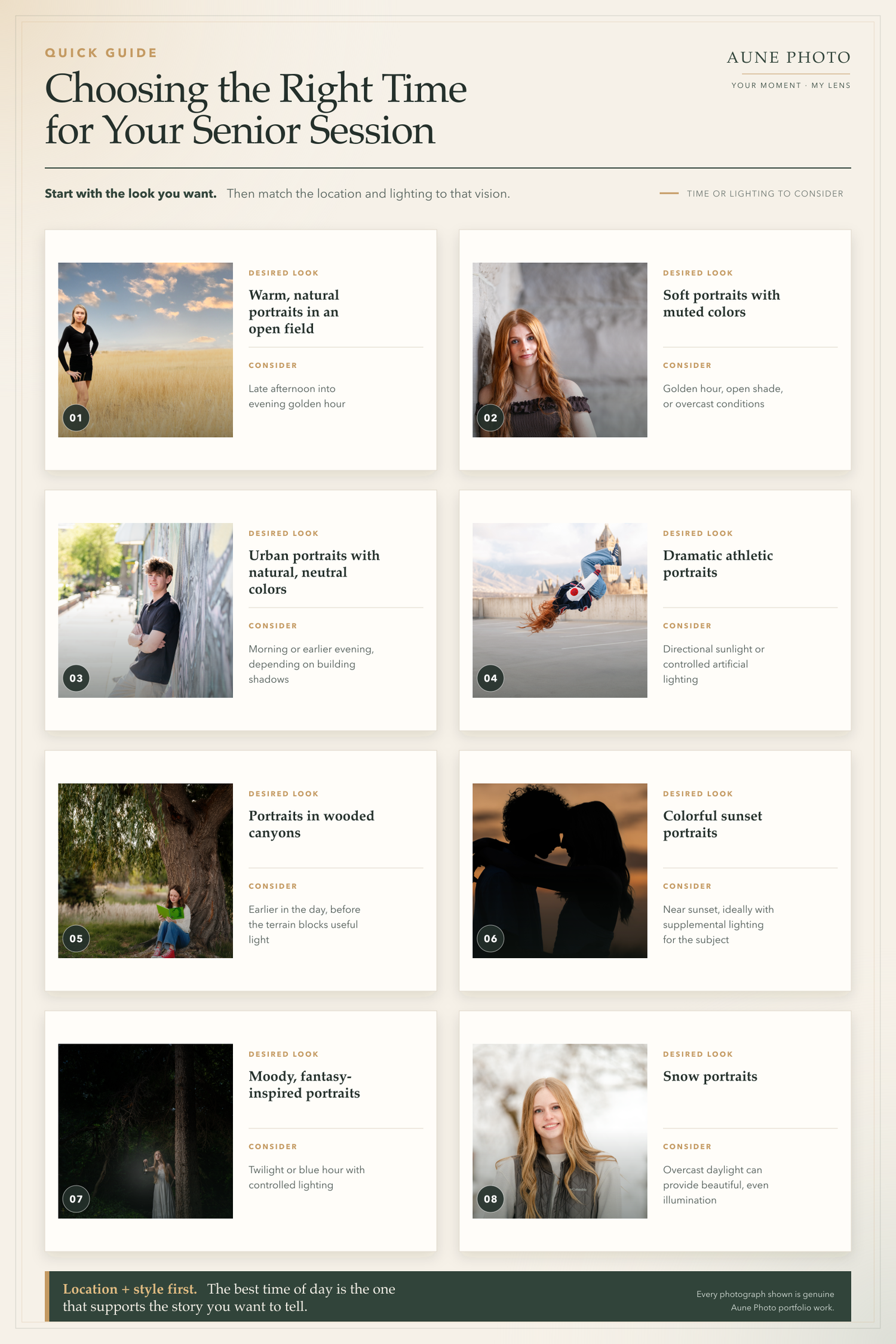
Quick Guide: Choosing the Right Time for Your Senior Session
These are starting points, not rigid rules. The best recommendation will always depend on the specific location, season, weather, and creative vision.
Frequently Asked Questions About Golden Hour Senior Pictures
Is golden hour really the best time for senior pictures? - Golden hour is often excellent for soft, warm, natural portraits, but it isn't the best choice for every location or style. Urban, athletic, and dramatic portraits may benefit from different lighting conditions.
How long before sunset should senior pictures start? - For an evening session intended to include golden-hour portraits, I often recommend beginning around 90 minutes before sunset. This allows us to capture a variety of lighting conditions as the sun gets lower. The ideal start time depends on the location, session length, and number of outfits.
Is sunrise or sunset better for senior pictures? - Both can produce beautiful results. In Utah, mountains can delay direct morning sunlight, sometimes reducing the classic golden-hour appearance. Morning sessions often offer fewer crowds and freshly styled hair and makeup, while evening sessions can provide more pronounced warm sunset light in suitable locations.
Can you take good senior pictures at noon? - Yes. Midday sunlight can be challenging because of strong shadows and high contrast, but an experienced photographer can use shade, careful positioning, reflectors, or professional lighting to create flattering portraits.
Are cloudy days good for senior pictures? - Often, yes. Cloud cover can soften sunlight and reduce harsh shadows, providing more flexibility in locations and posing. You may lose some of the warm sunset glow, but the lighting can still be beautiful.
Can you capture both the sunset and the senior clearly? - Yes, although it can be challenging when the sky is significantly brighter than the subject. Supplemental lighting, particularly portable strobes, can illuminate the senior while allowing the photographer to preserve the sunset's color and detail.
What is blue hour photography? - Blue hour refers to the twilight period when ambient light often takes on a cooler, blue appearance. It can be particularly effective for dramatic, cinematic, and creative portraits, especially when combined with supplemental lighting.
Final Thoughts: Chase the Photograph, Not the Clock
Golden hour is popular for a reason. The warm colors, low-angle sunlight, and beautiful atmosphere can create wonderful senior portraits. And for many seniors, it's exactly the right choice. But I don't believe the best senior portraits come from blindly following a particular time of day. They come from understanding the person we're photographing, choosing a location that complements their personality, and using lighting intentionally to create the look they want. Sometimes that's golden hour. Sometimes it's a cloudy afternoon. Sometimes it's a dramatic sunset illuminated with professional lighting. And sometimes it's a wooded canyon after sunset, with a cool blue forest and carefully controlled light on the subject.
The most important thing isn't what time the clock says. It's whether the lighting helps us tell your story.
Planning Your Senior Pictures in Utah?
At Aune Photo, I work with seniors and families to plan sessions around the locations, styles, and experiences that matter to them. Whether you're dreaming of warm sunset portraits, an urban session, or something entirely different, we'll discuss the lighting and timing that will best support your vision. Because your senior portraits should reflect who you are, not simply follow the latest photography trend.
Explore Aune Photo's senior portrait sessions and let's start planning something uniquely yours.


